In everyday dog training, a household may have clear intentions about jumping, nudging or barking for attention, yet repeat the same corrections every day. It helps to examine what happens after the correction as carefully as the words themselves.

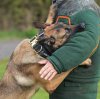
Consider an illustrative greeting. A dog stands beside an owner who is speaking to a visitor. Nobody responds until the dog jumps. The owner turns, talks and handles the dog, while the visitor laughs and strokes them. For a dog seeking attention, the sequence may still deliver something valuable. This example explains a possible learning pattern; it does not diagnose every dog who jumps.
Dog training: identify the outcome
The same behaviour can have different causes. Look at what precedes it, who is present and what follows. If jumping consistently brings back interaction that had stopped, attention is one possible consequence to investigate.
A reinforcer is defined by its effect on behaviour, not by the person's intention. Food is one example, but access to people or play can also matter. Equally, not every touch or spoken response rewards every dog. Repeated patterns in that dog's behaviour provide more useful evidence than a general assumption.
Notice the moments before the problem
Observe several ordinary greetings without deliberately provoking jumping. Record who arrived, what the dog did first, how people reacted and how the interaction ended. You may discover that appropriate approaches receive little response while jumping starts the conversation.
That observation identifies an earlier teaching opportunity. Arrange for a cooperative adult to acknowledge the dog while all four paws are still on the floor. The aim is to make an appropriate greeting effective before the dog resorts to the familiar alternative.

Make practice manageable
Start with one familiar adult and enough distance for success. A barrier can help prevent contact while the dog is learning. If jumping starts immediately, adjust the approach distance or excitement level before repeating the exercise.
Choose one clear initial goal, such as standing with four paws on the floor. A long sequence of commands can add difficulty without improving the greeting. Once the dog succeeds under familiar conditions, change one feature at a time, rather than expecting the skill to transfer immediately to a lively group of visitors.
Children and frightened guests should not be used as practice partners. Growling, snapping or attempts to escape call for a different assessment rather than simply repeating an attention-seeking greeting plan.
Make the household consistent
If one person waits for four paws on the floor while another welcomes jumping with a cuddle, the old behaviour can still work. Agreeing on how and when to greet matters alongside formal training.
Useful training changes the everyday interactions that maintain behaviour. It helps owners recognise an appropriate moment, deliver a meaningful consequence and organise situations in which the dog can succeed.
Siam Elite K9's Obedience Training can be discussed for everyday skills and cooperation. For more complex concerns involving fear or aggression, ask about Behavior Modification and describe the situations involved so the training approach can match the problem: Siam Elite K9
Discuss your dog's needs through the Siam Elite K9 contact page or Siam Elite K9 on Facebook.
References
Dogs Trust: How to stop your dog jumping up at people